
In JavaScript, the Call Stack is a core mechanism used by the engine to manage and track function execution.
- It keeps track of function calls in the order they are executed.
- It helps determine which function is currently running and what runs next.
Working of Call Stack
JavaScript operates in a single-threaded environment, meaning that it can only execute one operation at a time. The Call Stack is the part of JavaScript that keeps track of the execution process.
- Function Call: When a function is invoked, it is pushed onto the Call Stack and stays there until execution completes.
- Function Execution: The JavaScript engine executes the function’s code until it ends or calls another function.
- Nested Calls: If a function calls another function, the new function is pushed onto the stack while the previous one waits.
- Function Return: After execution finishes, the function is popped from the stack and control returns to the previous function.
- Program Completion: This continues until the stack is empty, indicating the program has finished executing.
function f1() {
    console.log('Hi by f1!');
}

function f2() {
    f1();
    console.log('Hi by f2!');
}

f2();
The steps and illustrations below explain the call stack of the above function.
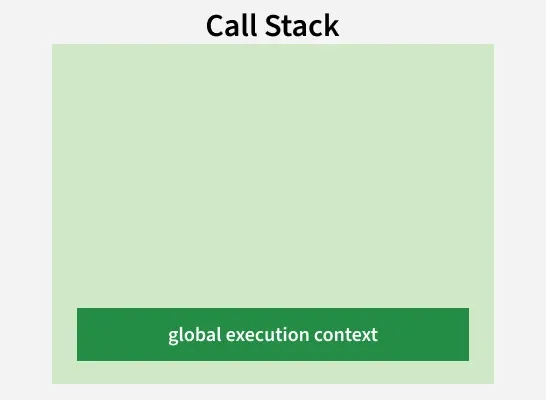
- [Step 1]: When the code loads in memory, the global execution context gets pushed in the stack.
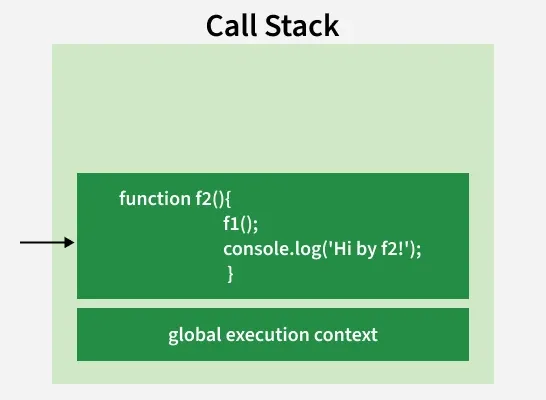
- [Step 2]: The f2() function gets called, and the execution context of f2() gets pushed into the stack.
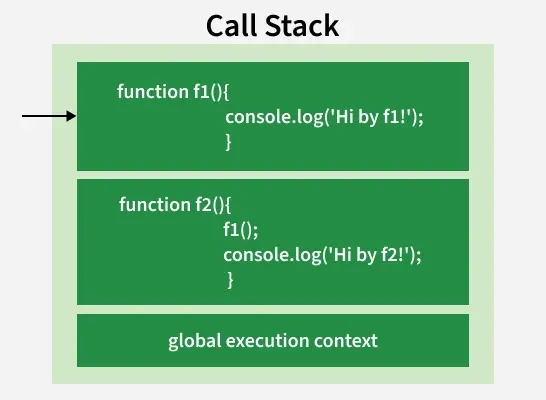
- [Step 3]: When f2() executes and calls f1(), the execution context of f1() is pushed onto the call stack.
- [Step 4]: Now the f1() function starts executing. A new stack frame of the console.log() method will be pushed to the stack.
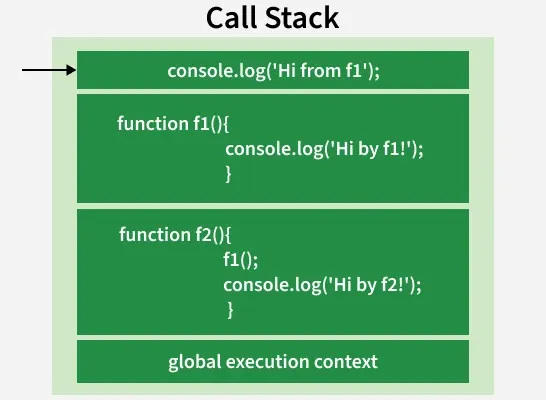
- [Step 5]: console.log() prints "Hi by f1" and is popped from the stack, followed by f1() once it completes.
- [Step 6]: Similarly, console.log() prints "Hi by f2", then f2() finishes and is popped from the call stack.
Stack Overflow
A stack overflow occurs when the call stack runs out of memory due to too many nested function calls.
- Commonly caused by infinite or uncontrolled recursion.
- Can also occur when too many function calls are made without returning.
function funcA() {
  funcB();
}

function funcB() {
  funcA();
}
- funcA calls funcB, which adds funcA to the stack.
- funcB calls funcA, which adds funcB again.
- This cycle continues, eventually exceeding the available stack space
Need of Call Stack
- Tracks Function Execution: Keeps track of which function is running at any given time.
- Handles Nested Calls: Manages nested function calls, ensuring that functions run in the correct order.
- Manages Recursion: Helps with recursive functions by keeping track of each function call.
- Ensures Correct Return: Returns execution to the appropriate point after a function completes.
- Manages Flow: Maintains proper execution order in programs with multiple functions.