
Python is a high level, interpreted and general-purpose dynamic programming language that focuses on code readability. It is used in many organizations as it supports multiple programming paradigms. It also performs automatic memory management. It is one of the world’s most popular, in-demand programming languages. This is for many reasons:
Python3
Of course, if something outside your program changes the clipboard contents, the
Python3
Use the emoji cheat sheet to find your favorite emoji.
Alternatively,
Python3
Hope you try it!
Python3
From now, you don't need to open those browsers for a quick search and get those hefty amounts of ads and distractions. Just howdoi!
Python3 1==
Python3
If you wish to get a particular number of sentences from the summary, just pass that as an argument to the
Python3
Python3
Output:
Python3
Output:
Python3
Output:
Python3 1==
This opens up a page in your web browser which contains a comical abstract of Python developed for your delight. Congratulations! You know have the ability to fly or for now the ability to visit this link https://xkcd.com/353/.
Python3
If the input is :
Python3 1==
The output would be:
Python3
Output:
Python3 1==
- It’s easy to learn.
- It’s super versatile.
- It has a huge range of modules and libraries.
Pyperclip
This module was created to enable cross-platform copy-pasting in Python which was earlier absent. Thepyperclip module has copy() and paste() functions that can send text to and receive text from your computer's clipboard. Sending the output of your program to the clipboard will make it easy to paste it on an email, word processor, or some other software.
Pyperclip does not come with Python. To install it, follow the directions for installing third party modules. After installing the module, enter the following into IDE:
# Python program to
# demonstrate pyperclip module


# This will import pyperclip
import pyperclip
pyperclip.copy("Hello world !")
pyperclip.paste()

pyperclip.copy("Isn't pyperclip interesting?")
pyperclip.paste()
paste() function will return it. For example, if this sentence is copied to the clipboard and then paste() is called, the output would look like this:
'For example, if this sentence is copied to the clipboard and then paste() is called, the output would look like this:'
Emoji
Emojis have become a way to express and to enhance simple boring texts. Now, the same gems can be used in Python programs too. Yes, really! You now have the ultimate power to use emojis in your code. For this,emoji module is needed to be installed.
In terminal. Use:
pip install emojiTo upgrade to the latest packages of emojis. Here's how it can be done:
pip install emoji --upgrade
from emoji import emojize
print(emojize(":thumbs_up:"))
encode() function can be used from emojis module to convert Unicode to emojis:
import emojis
emojified = emojis.encode("There is a :snake: in my boot !")
print(emojified)
Howdoi
Stuck on a coding problem? Wish to visit StackOverflow without leaving the terminal? Withhowdoi, you can do it!
Install the howdoi module by:
pip install howdoiOr install from Python by:
python setup.py installAsk whatever question you have and it will try it's best to answer it.
howdoi make trees in Python
howdoi commit in git
howdoi use Howdoi in Python
Wikipedia
As if howdoi wasn't enough, we can now import the entire Wikipedia! Yes, We can now import Wikipedia in Python usingWikipedia module. Use the incessant flow of knowledge with Python for daily needs.
Install it as:
pip install wikipediaAnd use it as:
import wikipedia
result = wikipedia.page("GeeksforGeeks")
print(result.summary)
summary() function:
import wikipedia
print(wikipedia.summary("Debugging", sentences = 2))
New types at runtime
This can create new types in a fully dynamic way. It's the same as creating a class but something new which you can show to your friends.# Python program to
# create new type object
# Creates a new type object
NewType = type("NewType", (object, ), {"attr": "hello newtype"})
New = NewType()
# Print the type of object
print(type(New))
# Print the attribute of object
print(New.attr)
<class '__main__.NewType'>
hello newtype
The above code is same as:
# Creates a class
class NewType:
    attr = "hello newtype"

# Initialize an object
New = NewType()

# Print the type of object
print(type(New))

# Print the attribute of object
print(New.attr)
<class '__main__.NewType'>
hello newtype
Probably not the best module but still worth a try!
Disassemble Python
Ever wondered what python does under the hood? With the standard library module dis, you can look easily.# This will import
# dis module
import dis
def test(number):
return (str(number)+str(number))
def newFunc(string):
print("Hello", string)
# This will display the
# disassembly of test():
dis.dis(test)
# This will display the
# disassembly of newFunc()
dis.dis(newFunc)
Result:
  8           0 LOAD_GLOBAL              0 (str)
              3 LOAD_FAST                0 (number)
              6 CALL_FUNCTION            1 (1 positional, 0 keyword pair)
              9 LOAD_GLOBAL              0 (str)
             12 LOAD_FAST                0 (number)
             15 CALL_FUNCTION            1 (1 positional, 0 keyword pair)
             18 BINARY_ADD
             19 RETURN_VALUE


  3           0 LOAD_GLOBAL              0 (print)
              3 LOAD_CONST               1 ('Hello')
              6 LOAD_FAST                0 (string)
              9 CALL_FUNCTION            2 (2 positional, 0 keyword pair)
             12 POP_TOP
             13 LOAD_CONST               0 (None)
             16 RETURN_VALUE
That's overwhelming and also amazing!
Antigravity
The reason this module is here is because this is quite fun! It's basically an easter egg in Python 3 which is used in Google App Engines. It was added to Google App Engines just as a medium to amuse the users. Install it with:pip install antigravityAnd then type this in your IDE to see the magic:
import antigravity
sys.exit()
You may have used the sys module before but did you know you could exit your program early using it? We can cause the program to terminate by calling thesys.exit() function. Since this function is in the sys module, firstly, the sys module should be imported. This is not a third party module and comes built-in with Python so there is no need to install it.
# This will import
# sys module
import sys

while True:
    print("Type 'exit' to exit")
    response = input()
    if response == "exit":
        print("Exiting the program")
        sys.exit()
    print("You typed", response)
"Geeky"
"GeeksforGeeks"
"exit"
The output will be :
Type 'exit' to exit
You typed Geeky

Type 'exit' to exit
You typed GeeksforGeeks

Type 'exit' to exit
Exiting the program
urllib
Urllib module is the URL handling module for python. It is used to fetch URLs (Uniform Resource Locators). It uses the urlopen function and is able to fetch URLs using a variety of different protocols. Urllib is a package that collects several modules for working with URLs, such as:- urllib.request for opening and reading.
- urllib.parse for parsing URLs
- urllib.error for the exceptions raised
- urllib.robotparser for parsing robot.txt files
# This will import urlopen
# class from urllib module
from urllib.request import urlopen


page = urlopen("https://www.geeksforgeeks.org/")
print(page.headers)
Server: Apache
Strict-Transport-Security: max-age=3600; includeSubDomains
Access-Control-Allow-Credentials: true
X-Frame-Options: DENY
X-Content-Type-Options: nosniff
Content-Type: text/html; charset=UTF-8
X-Akamai-Transformed: 9 - 0 pmb=mRUM,3
Vary: Accept-Encoding
Cache-Control: must-revalidate, max-age=3, s-maxage=21600
Date: Fri, 04 Oct 2019 04:57:37 GMT
Transfer-Encoding: chunked
Connection: close
Connection: Transfer-Encoding
Server-Timing: cdn-cache; desc=HIT
Server-Timing: edge; dur=1
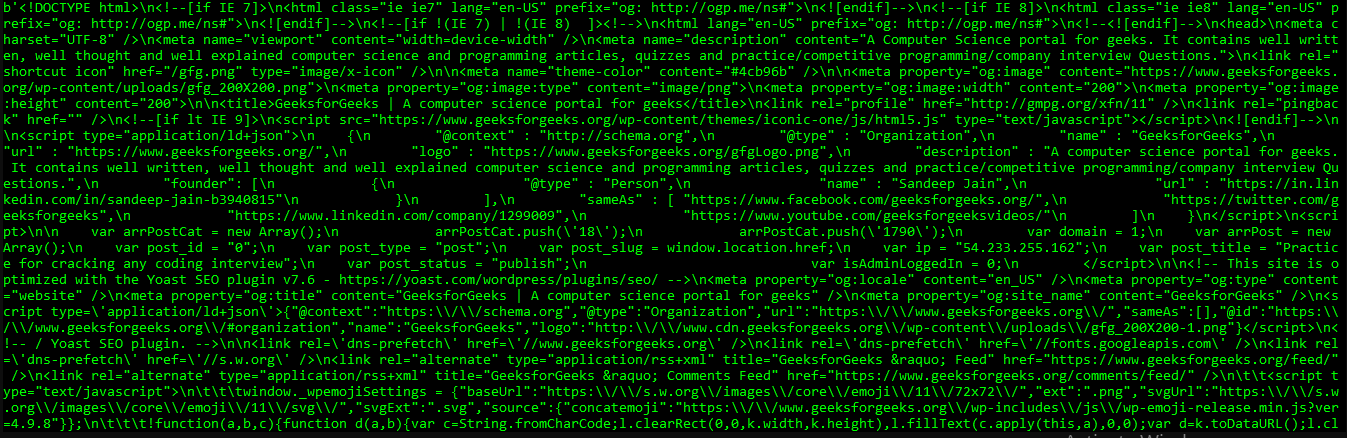
You can also see the coding of the website by using
read() function:
# This will import urlopen
# class from urllib module


from urllib.request import urlopen
page=urlopen("https://www.geeksforgeeks.org/")

# Fetches the code
# of the web page
content = page.read()

print(content)
Turtle
Yes, a turtle can be imported. Don't worry it's not slow. Turtle is a Python module to draw. It has a huge application and a number of methods which you can learn about in here. But with just a few basics, pretty cool stuff can be done. This module comes built-in with Python so there is no need to install it.# This will import turtle module
import turtle
myTurtle = turtle.Turtle()
myWin = turtle.Screen()
# Turtle to draw a spiral
def drawSpiral(myTurtle, linelen):
myTurtle.forward(linelen)
myTurtle.right(90)
drawSpiral(myTurtle, linelen-10)
drawSpiral(myTurtle, 80)
myWin.exitonclick()
Output:
