
Building a REST API in FastAPI involves decorating Python functions to handle specific HTTP methods. Using the @app decorator, you can define routes and manage requests with minimal boilerplate:
- @app.get: Retrieve data
- @app.post: Create data
- @app.put / @app.patch: Update data
- @app.delete: Remove data
Below is an example of a basic get route that returns a "Hello, FastAPI" message:
from fastapi import FastAPI

# creating app
app = FastAPI()

# defining api endpoint
@app.get("/")
def first_example():
    return {"message": "Hello, FastAPI!"}
Now, start the server using command:
uvicorn main:app --reload
Open the browser and open http://localhost:8000/docs or http://127.0.0.1:8000/docs . You will be able to see the Swagger UI Home page as below: 
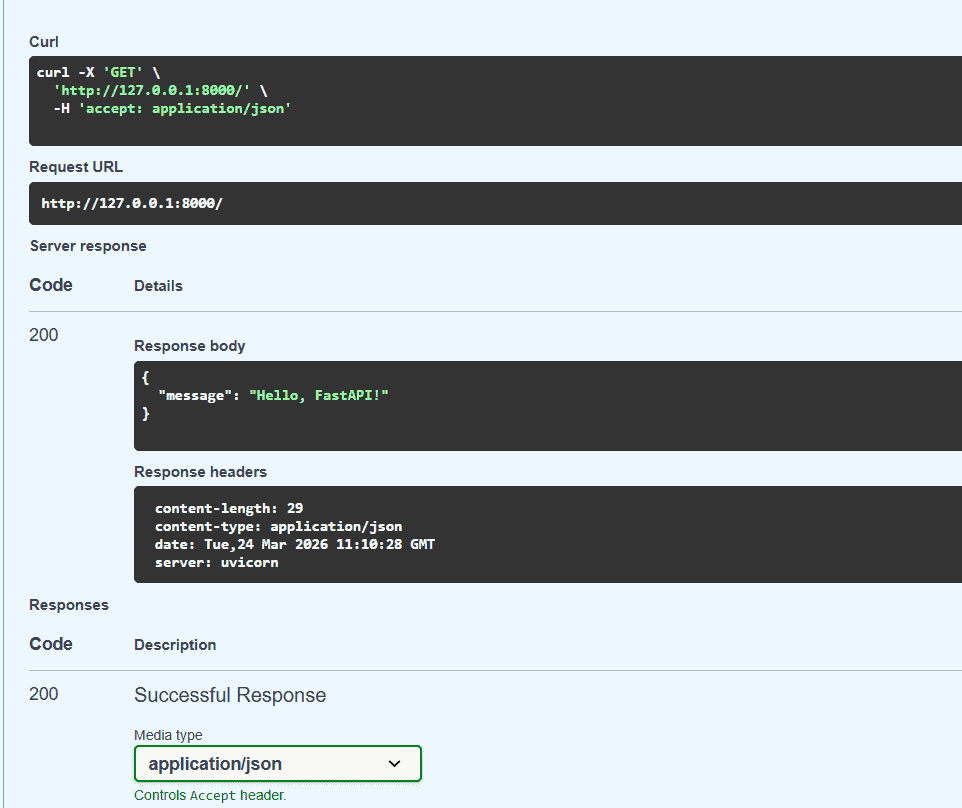
Now try to Execute the API, you will get the success status with 200 code. The Response will be as shown below:
CRUD Operations
Below is an example demonstrating CRUD operations using FastAPI:
from fastapi import FastAPI
from pydantic import BaseModel
app = FastAPI()

# CREATE
@app.post("/items/")
async def create_item(item: Item):
    ''' code implementation here '''

# READ
@app.get("/items/{item_id}")
async def read_item(item_id: int):
    ''' code implementation here '''

# UPDATE
@app.put("/items/{item_id}")
async def update_item(item_id: int, item: Item):
    ''' code implementation here '''

# DELETE
@app.delete("/items/{item_id}")
async def delete_item(item_id: int):
    ''' code implementation here '''
Explanation:
- app = FastAPI(): creates an app instance.
- @app.post() defines the endpoint to create a new item.
- @app.get() defines the endpoint to retrieve an item by ID.
- @app.put() defines the endpoint to update an existing item.
- @app.delete() defines the endpoint to delete an item.
For more details on CRUD operations, refer to the: FastAPI | CRUD Operations.