
Object-level permissions in Django REST Framework (DRF) allow you to control access to individual model instances. While standard permissions check whether a user can access a view, object-level permissions determine whether a user can perform actions on a specific object.
To implement custom object-level permissions, create a class that inherits from rest_framework.permissions.BasePermission and override one or both of the following methods:
- has_permission(self, request, view): Checks general access at the view level.
- has_object_permission(self, request, view, obj): Checks access for a specific object instance.
Even if general permissions are set on a model, any authenticated user might still be able to modify or delete objects. Custom object-level permissions ensure that only the owner of an object can update or delete it, preventing unauthorized actions on individual records
Creating customized permission class
Consider a project named 'robot_project' having an app named 'robots'. Inside the robots folder, create a new file named custompermission.py:
from rest_framework import permissions

class IsCurrentUserOwnerOrReadOnly(permissions.BasePermission):
    def has_object_permission(self, request, view, obj):
        if request.method in permissions.SAFE_METHODS:
            # The method is a safe method
            return True
        else:
            # The method isn't a safe method
            # Only owners are granted permissions for unsafe methods
            return obj.owner == request.user
IsCurrentUserOwnerOrReadOnly class inherits from BasePermission and overrides has_object_permission. Safe methods are allowed for all users, while unsafe methods are restricted to the object owner.
Updating the Robot Model
Add the owner field to the robots/models.py file.
owner = models.ForeignKey(
'auth.User',
related_name= 'robots',
on_delete=models.CASCADE
)
Complete Robot model:
class Robot(models.Model):
    CURRENCY_CHOICES = (
        ('INR', 'Indian Rupee'),
        ('USD', 'US Dollar'),
        ('EUR', 'Euro'),
    )

    name = models.CharField(max_length=150, unique=True)

    robot_category = models.ForeignKey(
        RobotCategory,
        related_name='robots',
        on_delete=models.CASCADE)

    manufacturer = models.ForeignKey(
        Manufacturer,
        related_name='robots',
        on_delete=models.CASCADE)

    currency = models.CharField(
        max_length=3,
        choices=CURRENCY_CHOICES,
        default='INR')

    price = models.IntegerField()

    manufacturing_date = models.DateTimeField()

    owner = models.ForeignKey(
        'auth.User',
        related_name='robots',
        on_delete=models.CASCADE
    )

    class Meta:
        ordering = ('name',)

    def __str__(self):
        return self.name
models.CASCADE ensures that deleting a user also deletes associated robots.
Updating the Serializer
Add the owner field in robots/serializers.py:
owner = serializers.ReadOnlyField(source='owner.username')
Full RobotSerializer:
class RobotSerializer(serializers.HyperlinkedModelSerializer):
    robot_category = serializers.SlugRelatedField(
        queryset=RobotCategory.objects.all(), slug_field='name')
    manufacturer = serializers.SlugRelatedField(
        queryset=Manufacturer.objects.all(), slug_field='name')
    currency = serializers.ChoiceField(choices=Robot.CURRENCY_CHOICES)
    currency_name = serializers.CharField(
        source='get_currency_display',
        read_only=True)
    owner = serializers.ReadOnlyField(source='owner.username')

    class Meta:
        model = Robot
        fields = '__all__'
User Serializers
class UserRobotSerializer(serializers.HyperlinkedModelSerializer):
    class Meta:
        model = Robot
        fields = ('url', 'name')

class UserSerializer(serializers.HyperlinkedModelSerializer):
    robots = UserRobotSerializer(many=True, read_only=True)

    class Meta:
        model = User
        fields = ('url', 'pk', 'username', 'robots')
UserRobotSerializer serializes a user's robots with minimal fields. UserSerializer nests the robots under the user.
Saving Owner Information
Override perform_create in RobotList:
class RobotList(generics.ListCreateAPIView):
    queryset = Robot.objects.all()
    serializer_class = RobotSerializer
    name = 'robot-list'

    def perform_create(self, serializer):
        serializer.save(owner=self.request.user)
The perform_create method passes the owner information to the create method using the serializer.save method.
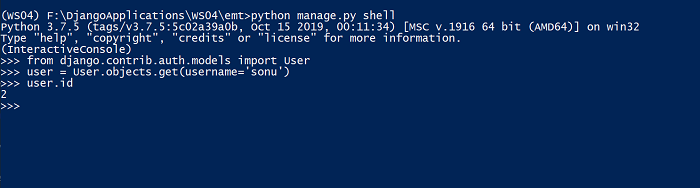
A new owner field has been added to the Robot table. Run the migrations to apply these changes to the database. For existing robot records, a default owner must be assigned by noting the ID of an existing user and providing it during the migration. The user ID can be found using the Django shell:
Migrations:
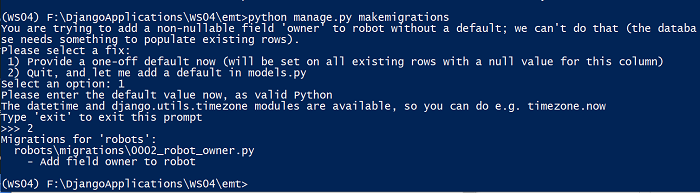
Run the "python manage.py migrate" command to apply the generated migrations.
Setting Authentication and Permissions
Add Basic Authentication in settings.py:
REST_FRAMEWORK = {
'DEFAULT_AUTHENTICATION_CLASSES':(
'rest_framework.authentication.BasicAuthentication',
)
}
Update views to include custom permissions:
from rest_framework import permissions
from robots import custompermission

class RobotList(generics.ListCreateAPIView):
    permission_classes = (
        permissions.IsAuthenticatedOrReadOnly,
        custompermission.IsCurrentUserOwnerOrReadOnly,
    )
    queryset = Robot.objects.all()
    serializer_class = RobotSerializer
    name = 'robot-list'

    def perform_create(self, serializer):
        serializer.save(owner=self.request.user)

class RobotDetail(generics.RetrieveUpdateDestroyAPIView):
    permission_classes = (
        permissions.IsAuthenticatedOrReadOnly,
        custompermission.IsCurrentUserOwnerOrReadOnly,
    )
    queryset = Robot.objects.all()
    serializer_class = RobotSerializer
    name = 'robot-detail'
Testing HTTP Requests
Retrieve robots (safe method, no authentication needed):
http :8000/robot/
Output:
HTTP/1.1 200 OK
Allow: GET, POST, HEAD, OPTIONS
Content-Language: en
Content-Length: 2116
Content-Type: application/json
Date: Sun, 29 Aug 2021 07:11:39 GMT
Referrer-Policy: same-origin
Server: WSGIServer/0.2 CPython/3.7.5
Vary: Accept, Accept-Language
X-Content-Type-Options: nosniff
X-Frame-Options: DENY
[
{
"currency": "USD",
"currency_name": "US Dollar",
"manufacturer": "Fanuc",
"manufacturing_date": "2019-10-12T00:00:00Z",
"name": "FANUC M-710ic/50",
"owner": "sonu",
"price": 37000,
"robot_category": "Articulated Robots",
"url": "http://localhost:8000/robot/1/"
},
{
"currency": "USD",
"currency_name": "US Dollar",
"manufacturer": "ABB",
"manufacturing_date": "2020-05-10T00:00:00Z",
"name": "IRB 1100",
"owner": "sonu",
"price": 25000,
"robot_category": "Articulated Robots",
"url": "http://localhost:8000/robot/7/"
},
]
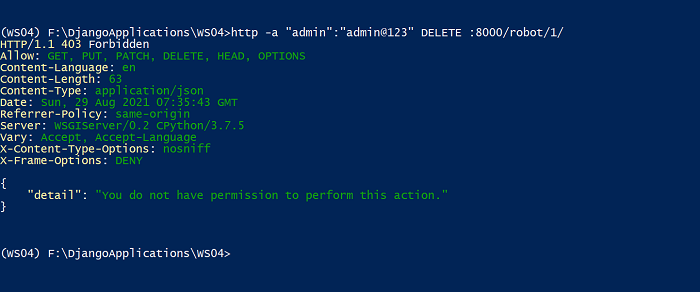
Delete a robot (only owner allowed):
Superuser:
http -a "admin":"admin@123" DELETE :8000/robot/1/
Output:
Owner:
http -a "sonu":"sn@pswrd" DELETE :8000/robot/1/
Output:
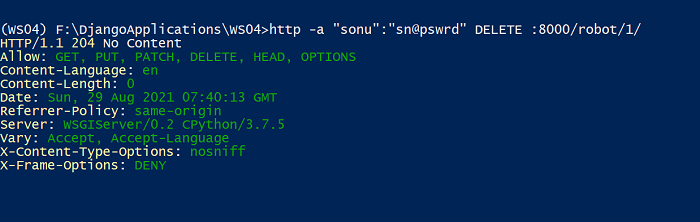
Output shows the robot is deleted only when the authenticated user is the owner.