
DateTimeField is a Django model field used to store both date and time values.
- Represented in Python as a datetime.datetime object.
- Stores a combined date and time value in the database.
- The default form widget is DateTimeInput.
- In Django Admin, it is displayed as two separate inputs (date and time) with JavaScript shortcuts.
Syntax
field_name = models.DateTimeField(**options)
Optional Arguments for DateTimeField
DateTimeField provides some additional useful options:
1. auto_now=True
Automatically sets the field to the current date and time every time the object is saved.
This is commonly used for "last modified" timestamps.
updated_at = models.DateTimeField(auto_now=True)
- The current date/time is always used, it is not just a default value.
- You cannot override it manually.
- The field updates only when calling Model.save().
- It does NOT update when using QuerySet.update() unless you explicitly set it.
Example:
Model.objects.filter(id=1).update(updated_at=timezone.now())
2. auto_now_add=True
Automatically sets the field to the current date and time when the object is first created. This is typically used for creation timestamps.
created_at = models.DateTimeField(auto_now_add=True)
- The value is set only once during creation.
- Even if you provide a value while creating the object, it will be ignored.
- You cannot manually override it.
3. Using default
To keep the field editable or manually modifiable, use default instead of auto_now_add.
from django.utils import timezone
published_at = models.DateTimeField(default=timezone.now)
This is the recommended approach in modern Django projects because it respects USE_TZ=True.
Note: The options auto_now_add, auto_now, and default are mutually exclusive. Any combination of these options will result in an error.
Django Model DateTimeField Example
Consider a project named geeksforgeeks having an app named geeks.
In models.py:
from django.db import models

class GeeksModel(models.Model):
    geeks_field = models.DateTimeField()

    def __str__(self):
        return str(self.geeks_field)
After running makemigrations and migrate, Django creates the corresponding database table with a DateTime column that stores both date and time values.
Opening Django Shell
Validation can be tested interactively by opening the Django shell:
python manage.py shell
Creating an Instance in Shell
Since modern Django projects usually have USE_TZ = True, it is recommended to use timezone-aware datetime values.
from geeks.models import GeeksModel
from django.utils import timezoneGeeksModel.objects.create(
geeks_field=timezone.now()
)
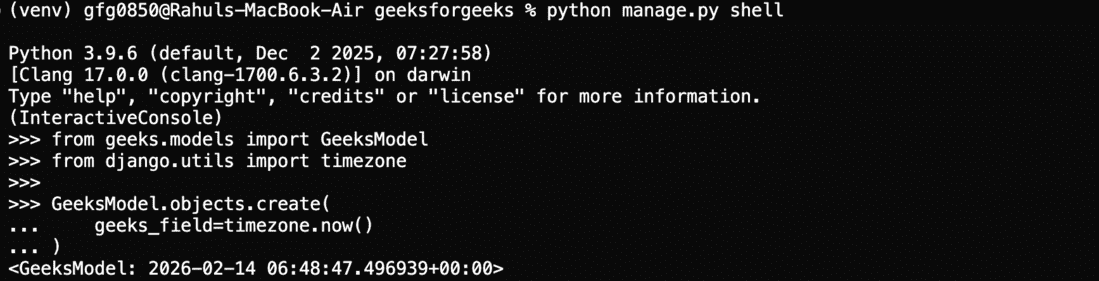
Stored objects can be retrieved using:
GeeksModel.objects.all()

This confirms that the DateTimeField successfully stores a datetime.datetime object in the database.
Validation Using Django Admin
The DateTimeField can also be validated using the Django Admin interface.
Register the Model in geeks/admin.py:
from django.contrib import admin
from .models import GeeksModel

admin.site.register(GeeksModel)
Create a Superuser:
Enter username, email, and password when prompted.
python manage.py createsuperuser
Run the Development Server:
python manage.py runserver
Visit: http://127.0.0.1:8000/admin/ and log in using the superuser credentials, then navigate to the Geeks models section.
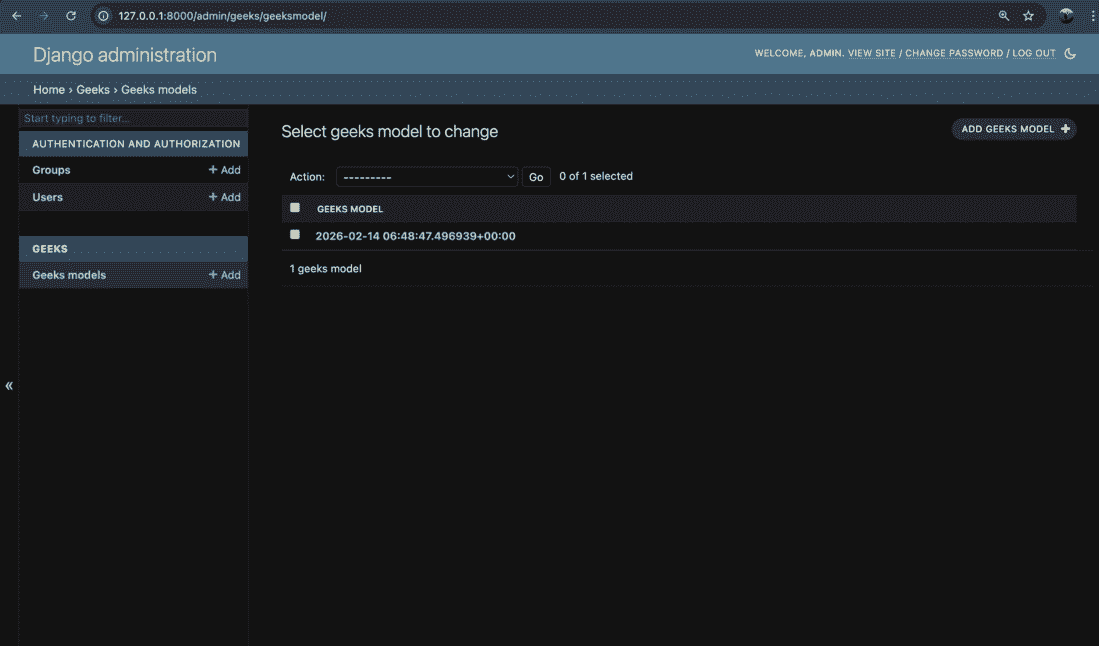
New instances can be added from this interface, and saved records can be viewed directly within the admin panel.
Field Options
Field options are arguments provided to a model field to apply constraints or define specific behavior for that field. For example, adding the argument null=True to a DateTimeField allows the corresponding database column to store NULL values in a relational database.
Below are the common field options and attributes that a DateTimeField can use:
| Field Options | Description |
|---|---|
| Null | If True, Django will store empty values as NULL in the database. Default is False. |
| Blank | If True, the field is allowed to be blank. Default is False. |
| db_column | The name of the database column to use for this field. If this isn't given, Django will use the field's name. |
| Default | The default value for the field. This can be a value or a callable object. If callable it will be called every time a new object is created. |
| help_text | Extra "help" text to be displayed with the form widget. It's useful for documentation even if your field isn't used on a form. |
| primary_key | If True, this field is the primary key for the model. |
| editable | If False, the field will not be displayed in the admin or any other ModelForm. They are also skipped during model validation. Default is True. |
| error_messages | The error_messages argument lets you override the default messages that the field will raise. Pass in a dictionary with keys matching the error messages you want to override. |
| help_text | Extra “help” text to be displayed with the form widget. It’s useful for documentation even if your field isn’t used on a form. |
| verbose_name | A human-readable name for the field. If the verbose name isn’t given, Django will automatically create it using the field’s attribute name, converting underscores to spaces. |
| validators | A list of validators to run for this field. See the validators documentation for more information. |
| Unique | If True, this field must be unique throughout the table. |