
Inheritance is a fundamental concept in object-oriented programming (OOP) that allows a class (called a child or derived class) to inherit attributes and methods from another class (called a parent or base class).
Here, a parent class Animal is created that has a method info(). Then a child class Dog is created that inherits from Animal and adds additional behavior.
class Animal:
    def __init__(self, name):
        self.name = name

    def info(self):
        print("Animal name:", self.name)

class Dog(Animal):
    def sound(self):
        print(self.name, "barks")

d = Dog("Buddy")
# Inherited method
d.info()
d.sound()
Output
Animal name: Buddy
Buddy barks
Explanation:
- class Animal defines the parent class.
- info() prints the name of the animal.
- class Dog(Animal) defines Dog as a child of Animal class.
- d.info() calls parent method info() and d.sound() calls child method.
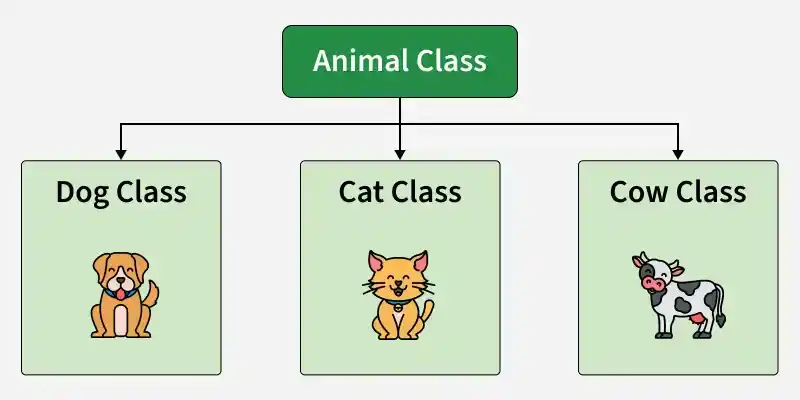
Benefits Of Inheritance
- Promotes code reusability by sharing attributes and methods across classes.
- Models real-world hierarchies like Animal -> Dog or Person -> Employee.
- Simplifies maintenance through centralized updates in parent classes.
- Enables method overriding for customized subclass behavior.
- Supports scalable, extensible design using polymorphism.
super() Function
super() function is used to call methods from a superclass following Python’s Method Resolution Order (MRO). In particular, it is commonly used in the child class's __init__() method to initialize inherited attributes. This way, the child class can leverage the functionality of the parent class.
Example: Here, Dog uses super() to call Animal's constructor
# Parent Class: Animal
class Animal:
    def __init__(self, name):
        self.name = name

    def info(self):
        print("Animal name:", self.name)

# Child Class: Dog
class Dog(Animal):
    def __init__(self, name, breed):
        # Calls constructor based on MRO
        super().__init__(name)
        self.breed = breed

    def details(self):
        print(self.name, "is a", self.breed)

d = Dog("Buddy", "Golden Retriever")
d.info()      # Parent method
d.details()   # Child method
Output
Animal name: Buddy
Buddy is a Golden Retriever
Explanation:
- super() function is used inside __init__() method of Dog to call the constructor of Animal and initialize inherited attribute (name).
- This ensures that parent class functionality is reused without needing to rewrite the code in the child class.
Method Overriding in Inheritance
Method overriding allows a child class to provide its own implementation of a method that already exists in the parent class. This enables customized behavior while still maintaining the inheritance relationship.
class Animal:
    def sound(self):
        print("Animal sound")

class Dog(Animal):
    def sound(self):
        print("Bark")

d = Dog()
d.sound()
Output
Bark
Explanation:
- Animal defines a method sound().
- Dog inherits from Animal and overrides the sound() method.
- When d.sound() is called, Python executes the overridden method in the child class instead of the parent class method.