
The numpy.polymul() method evaluates the product of two polynomials and returns the polynomial resulting from the multiplication of two input polynomials 'p1' and 'p2'.
Python3 1==
Python3 1==
Python3 1==
Syntax : numpy.polymul(p1, p2) Parameters : p1 : [array_like or poly1D]Input polynomial 1. p2 : [array_like or poly1D]Input polynomial 2. Return: Polynomial resulting from multiplication of the inputs.If either input is
poly1D object, then the output is also a poly1D object otherwise, 1D array of polynomial coefficients in decreasing order of degree.
Code : Python code explaining polymul()
# Python code explaining
# numpy.polymul()

# importing libraries
import numpy as np
import pandas as pd

# Constructing polynomial
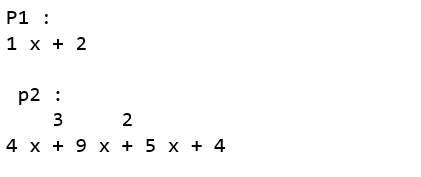
p1 = np.poly1d([1, 2])
p2 = np.poly1d([4, 9, 5, 4])

print ("P1 : ", p1)
print ("\n p2 : \n", p2)
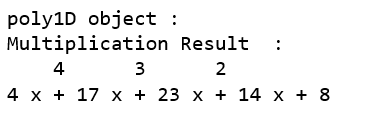
mul = np.polymul(p2, p1)

print("\n\npoly1D object : ")
print("Multiplication Result  : \n", mul)
# Defining ndarray
x = np.array([1, 2])
y = np.array([4, 9, 5, 4])
mul = np.polymul(y, x)

print("\n1D array : ")
print("Multiplication Result  : ", mul)
