In this article, we will discuss how to do matrix-vector multiplication in NumPy.
Matrix multiplication with Vector
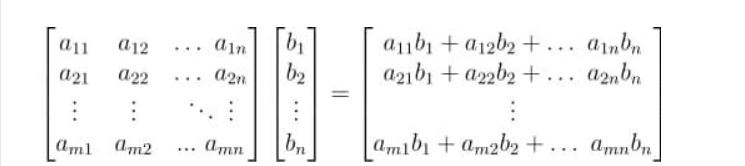
For a matrix-vector multiplication, there are certain important points:
- The end product of a matrix-vector multiplication is a vector.
- Each element of this vector is obtained by performing a dot product between each row of the matrix and the vector being multiplied.
- The number of columns in the matrix is equal to the number of elements in the vector.
# a and b are matrices
prod = numpy.matmul(a,b)
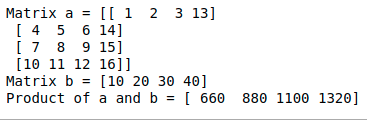
For matrix-vector multiplication, we will use np.matmul() function of NumPy, we will define a 4 x 4 matrix and a vector of length 4.
import numpy as np

a = np.array([[1, 2, 3, 13],
              [4, 5, 6, 14],
              [7, 8, 9, 15],
              [10, 11, 12, 16]])

b = np.array([10, 20, 30, 40])

print("Matrix a =", a)
print("Matrix b =", b)
print("Product of a and b =",
      np.matmul(a, b))
Output:
Matrix multiplication with another Matrix
We use the dot product to do matrix-matrix multiplication. We will use the same function for this also.
prod = numpy.matmul(a,b) # a and b are matrices
For a matrix-matrix multiplication, there are certain important points:
- The number of columns in the first matrix should be equal to the number of rows in the second matrix.
- If we are multiplying a matrix of dimensions m x n with another matrix of dimensions n x p, then the resultant product will be a matrix of dimensions m x p
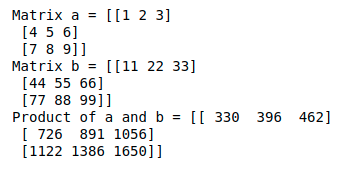
We will define two 3 x 3 matrix:
import numpy as np

a = np.array([[1, 2, 3],
              [4, 5, 6],
              [7, 8, 9]])

b = np.array([[11, 22, 33],
              [44, 55, 66],
              [77, 88, 99]])

print("Matrix a =", a)
print("Matrix b =", b)
print("Product of a and b =", np.matmul(a, b))
Output: