
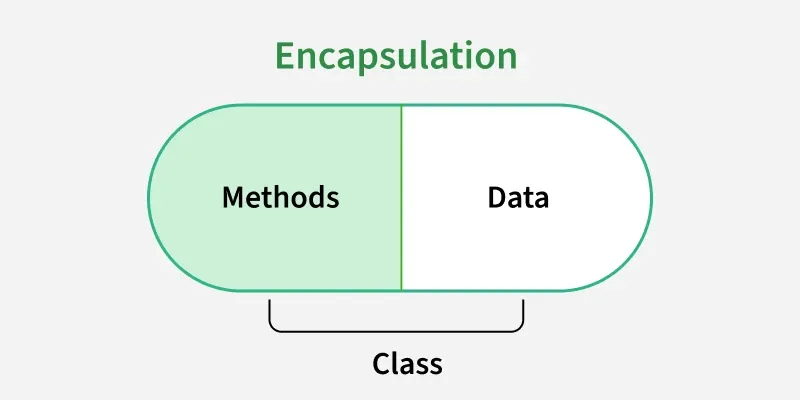
Encapsulation is one of the fundamental concepts of Object-Oriented Programming (OOP) in Java. It refers to wrapping data members and methods into a single unit called a class. Encapsulation helps protect data, improves code maintainability, and provides controlled access to variables through methods.
- Combines data and methods into a single unit (class).
- Improves data security by restricting direct access to variables.
- Supports abstraction by hiding implementation details from other classes.
Implementation of Encapsulation in C++
- Declare variables as private: Keep the class data members private so that they cannot be accessed directly from outside the class. This ensures data hiding.
- Use getters and setters: Provide public functions (getters and setters) to access and modify private variables safely. These methods can also include validation to ensure only valid data is assigned.
- Apply proper access specifiers: Use private for data members to hide information and public for member functions that provide controlled access to the data.
#include <iostream>
#include <string>
using namespace std;

// Class representing a Programmer
class Programmer
{
  private:
    string name; // Private variable

  public:
    // Getter method to access the private data
    string getName()
    {
        return name;
    }

    // Setter method to modify the private data
    void setName(string newName)
    {
        name = newName;
    }
};

int main()
{
    Programmer p;
    p.setName("Geek");                        // Set the name
    cout << "Name=> " << p.getName() << endl; // Get the name
    return 0;
}
Output
Name=> Geek
Explanation: In the above example, we use the encapsulation and use getter (getName) and setter (setName) methods which are used to access and modify the private data. This encapsulation mechanism protects the internal state of the Programmer object and allows for better control and flexibility in how the name attribute is accessed and modified.
Best Practices for Encapsulation
- Make class data private to hide implementation details and reduce coupling.
- Use getter and setter functions instead of public fields to control access.
- Ensure only valid values are assigned to private variables.
- Do not provide setters for data that should not be modified externally (e.g., IDs).
Advantages of Encapsulation
- Data Hiding: Encapsulation restricts direct access to private class variables, protecting sensitive data from unauthorized access.
- Improved Maintainability: You can change the internal implementation of a class without affecting code that uses the class.
- Enhanced Security: Encapsulation allows validation and control over data in setter methods, preventing invalid or harmful values.
- Code Reusability: Encapsulated classes can be reused in different programs without exposing internal details.
- Better Modularity: Encapsulation keeps data and methods together in a class, promoting organized and modular code.
Situations where Encapsulation may not be suitable
- When keeping the code minimal and simple is a priority.
- When even small performance overhead from function calls should be avoided.
- When direct access to data or greater flexibility is required for extension or usage.