
AnchorLayout in Kivy is used to place widgets at fixed positions like top, center, or bottom inside the window. It keeps widgets at the selected position even when the window size changes.
Example: In this example, a TextInput is placed at the center of the window using AnchorLayout using .kv file.
# main.py
from kivy.app import App
from kivy.uix.anchorlayout import AnchorLayout

class Main(AnchorLayout):
    pass

class Demo(App):
    def build(self):
        return Main()

Demo().run()
# demo.kv
<Main>:
    anchor_x: "center"
    anchor_y: "center"

    TextInput:
        text: "Enter name"
        size_hint: .5, .2
Output
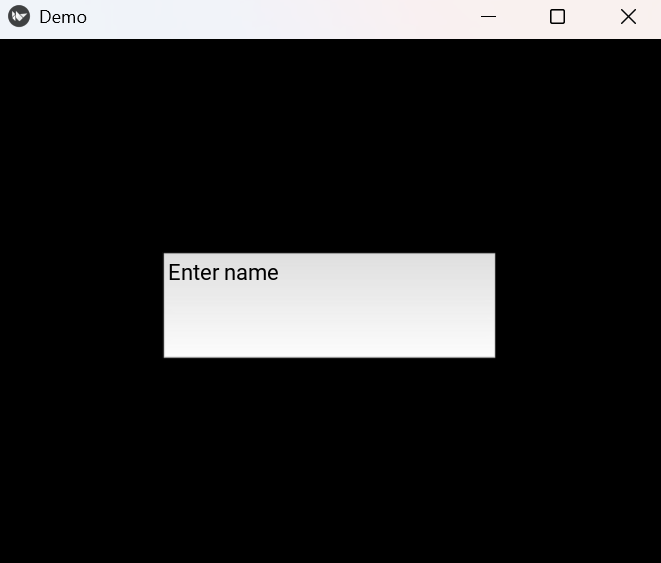
Explanation:
- Main(AnchorLayout) creates an anchor container
- anchor_x: "center" sets horizontal center
- anchor_y: "center" sets vertical center
- TextInput creates the text box
- size_hint controls width and height
Syntax
AnchorLayout(anchor_x="center", anchor_y="center")
Parameters:
- anchor_x: Horizontal alignment -> 'left', 'center', 'right'
- anchor_y: Vertical alignment -> 'top', 'center', 'bottom'
Examples
Example 1: In this example, a button is placed at the top-left of the window.
# main.py
from kivy.app import App
from kivy.uix.anchorlayout import AnchorLayout

class Main(AnchorLayout):
    pass

class Demo(App):
    def build(self):
        return Main()

Demo().run()
# demo.kv
<Main>:
    anchor_x: "left"
    anchor_y: "top"

    Button:
        text: "Top Left"
        size_hint: .4, .2
Output
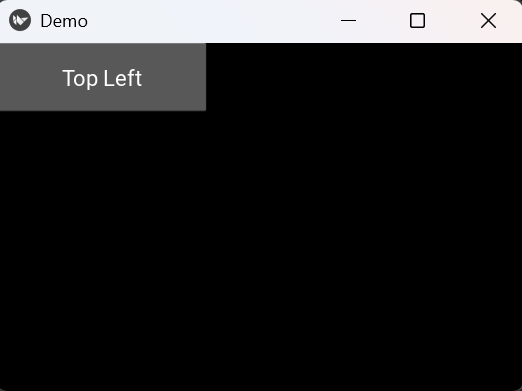
Explanation:
- anchor_x: "left" moves widget to left
- anchor_y: "top" moves widget to top
- Button creates the button
- size_hint sets button size
Example 2: This program places a label at the bottom-right of the screen.
# main.py
from kivy.app import App
from kivy.uix.anchorlayout import AnchorLayout

class Main(AnchorLayout):
    pass

class Demo(App):
    def build(self):
        return Main()

Demo().run()
# demo.kv
<Main>:
    anchor_x: "right"
    anchor_y: "bottom"

    Label:
        text: "Bottom Right"
        size_hint: None, None
        size: 150, 40
Output
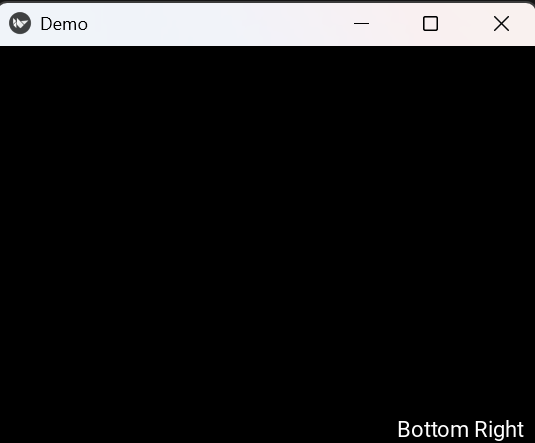
Explanation:
- anchor_x: "right" aligns widget to right
- anchor_y: "bottom" aligns widget to bottom
- Label creates the text
- size sets fixed size