
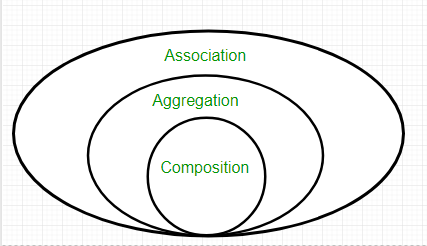
In object-oriented programming, relationships between classes play a crucial role in defining how objects interact with each other. Java, being an object-oriented language, provides mechanisms to model these relationships through association, aggregation, and composition. These describes how instances of classes relate to each other.
Association
Association is the cardinal concept in object-oriented programming that describes the relationship between two independent classes. Association can be viewed as describing a "uses-a" relationship where an object uses, or in any way interacts with, another object. Association may be either unidirectional or bidirectional and may exist in several forms, such as one-to-one, one-to-many, many-to-one, and many-to-many.
Types of Association
- Unidirectional Association: This association is the one in which one class is aware and associated with another class; the reverse is not true. For example, the Student class can be associated with the LibraryCard class, for the association where the student has a library card; a LibraryCard does not need to 'know about' a Student.
- Bidirectional Association: In this type of association, the classes are aware of each other and interact with one another. For example, a Teacher class and a Classroom class may be associated bidirectionally; there would be a teacher assigned to a classroom, and a classroom would know to which teacher it is assigned.
Example:
import java.io.*;
import java.util.*;

// Class 1
// Bank class
class Bank {

    // Attributes of bank
    private String bankName;
    private Set<Employee> employees;

    // Constructor of Bank class
    public Bank(String bankName)
    {
        this.bankName = bankName;
    }

    // Method of Bank class
    public String getBankName()
    {
        // Returning name of bank
        return this.bankName;
    }

    public void setEmployees(Set<Employee> employees)
    {
        this.employees = employees;
    }

    public Set<Employee> getEmployees()
    {
        return this.employees;
    }
}

// Class 2
// Employee class
class Employee {

    // Attributes of employee
    private String name;

    // Constructor of Employee class
    public Employee(String name)
    {
        // this keyword refers to current instance
        this.name = name;
    }

    // Method of Employee class
    public String getEmployeeName()
    {
        // returning the name of employee
        return this.name;
    }
}

// Class 3
// Association between both the
// classes in main method
class AssociationExample {

    // Main driver method
    public static void main(String[] args)
    {
        // Creating Employee objects
        Employee emp1 = new Employee("Ridhi");
          Employee emp2 = new Employee("Vijay");

          // adding the employees to a set
        Set<Employee> employees = new HashSet<>();
        employees.add(emp1);
          employees.add(emp2);

          // Creating a Bank object
          Bank bank = new Bank("ICICI");

          // setting the employees for the Bank object
        bank.setEmployees(employees);

          // traversing and displaying the bank employees
          for (Employee emp : bank.getEmployees()) {
              System.out.println(emp.getEmployeeName()
                                 + " belongs to bank "
                                 + bank.getBankName());
        }
    }
}
Output
Ridhi belongs to bank ICICI
Vijay belongs to bank ICICI
Explanation:
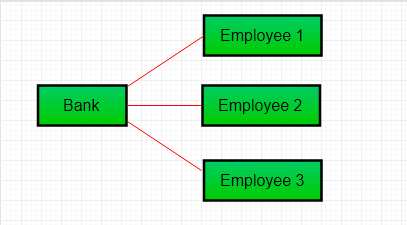
In the above example, two separate classes Bank and Employee are associated through their Objects. Bank can have many employees, So, it is a one-to-many relationship.
Aggregation
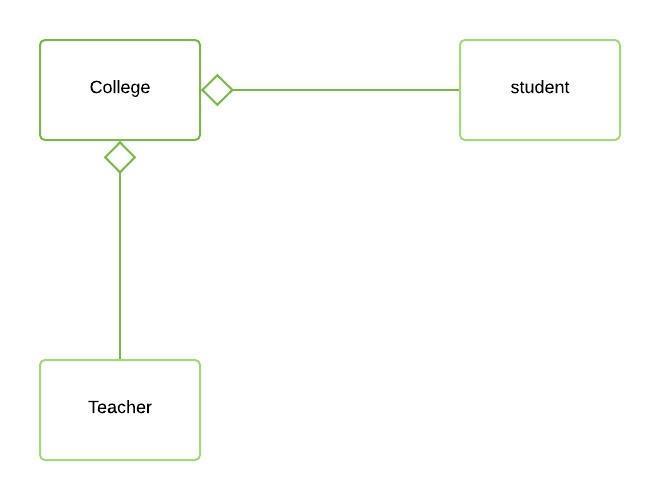
Aggregation is an object-oriented programming relationship that represents a “has-a” association with weak ownership. In aggregation, the contained object can exist independently of the container, making it useful for building modular and reusable software components.
It is a special form of Association where:
- It represents Has-A's relationship.
- It is a unidirectional association i.e. a one-way relationship. For example, a department can have students but vice versa is not possible and thus unidirectional in nature.
- In Aggregation, both entries can survive individually which means ending one entity will not affect the other entity.
Example:
import java.io.*;
import java.util.*;

// Class 1
// Student class
class Student {

    // Attributes of Student
    private String studentName;
    private int studentId;

    // Constructor of Student class
    public Student(String studentName, int studentId)
    {
        this.studentName = studentName;
        this.studentId = studentId;
    }

    public int getstudentId() {
      return studentId;
    }

    public String getstudentName() {
      return studentName;
    }
}

// Class 2
// Department class
// Department class contains list of Students
class Department {

    // Attributes of Department class
    private String deptName;
    private List<Student> students;

    // Constructor of Department class
    public Department(String deptName, List<Student> students)
    {
        this.deptName = deptName;
        this.students = students;
    }

    public List<Student> getStudents() {
      return students;
    }

    public void addStudent(Student student)
    {
        students.add(student);
    }
}

// Class 3
// Institute class
// Institute class contains the list of Departments
class Institute {

    // Attributes of Institute
    private String instituteName;
    private List<Department> departments;

    // Constructor of Institute class
    public Institute(String instituteName,
                     List<Department> departments)
    {
        // This keyword refers to current instance itself
        this.instituteName = instituteName;
        this.departments = departments;
    }

    public void addDepartment(Department department)
    {
        departments.add(department);
    }

    // Method of Institute class
    // Counting total students in the institute
    public int getTotalStudentsInInstitute()
    {
        int noOfStudents = 0;
        List<Student> students = null;

        for (Department dept : departments) {
            students = dept.getStudents();

            for (Student s : students) {
                noOfStudents++;
            }
        }
        return noOfStudents;
    }
}

// Class 4
// main class
class AggregationExample {

    // main driver method
    public static void main(String[] args)
    {
        // Creating independent Student objects
        Student s1 = new Student("Parul", 1);
        Student s2 = new Student("Sachin", 2);
        Student s3 = new Student("Priya", 1);
        Student s4 = new Student("Rahul", 2);

        // Creating an list of CSE Students
        List<Student> cse_students = new ArrayList<Student>();
        cse_students.add(s1);
        cse_students.add(s2);

        // Creating an initial list of EE Students
        List<Student> ee_students = new ArrayList<Student>();
        ee_students.add(s3);
        ee_students.add(s4);

        // Creating Department object with a Students list
        // using Aggregation (Department "has" students)
        Department CSE = new Department("CSE", cse_students);
        Department EE = new Department("EE", ee_students);

        // Creating an initial list of Departments
        List<Department> departments = new ArrayList<Department>();
        departments.add(CSE);
        departments.add(EE);

        // Creating an Institute object with Departments list
        // using Aggregation (Institute "has" Departments)
        Institute institute = new Institute("BITS", departments);

        // Display message for better readability
        System.out.print("Total students in institute: ");

        // Calling method to get total number of students
        // in the institute and printing on console
        System.out.print(
            institute.getTotalStudentsInInstitute());
    }
}
Output
Total students in institute: 4
Explanation:
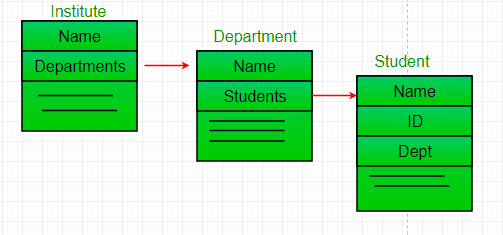
- There is an Institute which has no. of departments like CSE, EE. Every department has no. of students.
- So, we make an Institute class that has a reference to Object or no. of Objects (i.e. List of Objects) of the Department class.
- That means Institute class is associated with Department class through its Object(s).
- And Department class has also a reference to Object or Objects (i.e. List of Objects) of the Student class means it is associated with the Student class through its Object(s).
It represents a Has-A relationship. In the above example: Student Has-A name. Student Has-A ID. Department Has-A Students as depicted from the below media.
Note: Code reuse is best achieved by aggregation.
Composition
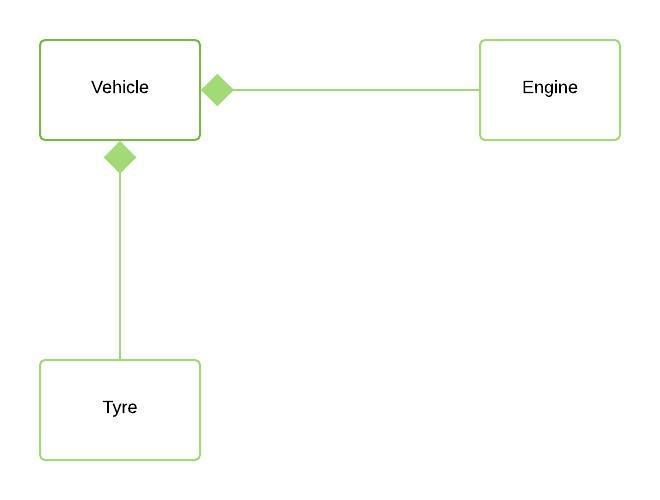
Composition is a strong “part-of” relationship in object-oriented programming where the contained object’s lifecycle is completely dependent on the container object. It represents a restricted form of aggregation in which parts cannot exist independently of the whole, making it ideal for modeling tightly coupled components in complex systems.
- It represents part-of relationship.
- In composition, both entities are dependent on each other.
- When there is a composition between two entities, the composed object cannot exist without the other entity.
Example:
import java.io.*;
import java.util.*;

// Room class
class Room {

    private String roomName;

    public Room(String roomName) {
        this.roomName = roomName;
    }

    public String getRoomName() {
        return roomName;
    }
}

// House class
class House {

    private String houseName;
    private List<Room> rooms;

    public House(String houseName) {
        this.houseName = houseName;
        this.rooms = new ArrayList<>();
    }

    public void addRoom(Room room) {
        rooms.add(room);
    }

    public List<Room> getRooms() {
        return new ArrayList<>(rooms);
    }

    public int getTotalRooms() {
        return rooms.size();
    }
}

// Main class
class CompositionExample {

    public static void main(String[] args) {
        House house = new House("Dream House");

        house.addRoom(new Room("Living Room"));
        house.addRoom(new Room("Bedroom"));
        house.addRoom(new Room("Kitchen"));
        house.addRoom(new Room("Bathroom"));

        int r = house.getTotalRooms();
        System.out.println("Total Rooms: " + r);

        System.out.println("Room names: ");
        for (Room room : house.getRooms()) {
            System.out.println("- " + room.getRoomName());
        }
    }
}
Output
Total Rooms: 4
Room names:
- Living Room
- Bedroom
- Kitchen
- Bathroom
Explanation:
In the above example, if the house is destroyed, its room also get destroyed this represents a complete composition relationship, where the room is the part of the house and the life cycle of room completely depends on the house.
Difference Between Association, Aggregation and Composition
Feature | Association | Aggregation | Composition |
|---|---|---|---|
Definition | General relationship between two classes | A special form of association with a "has-a" relationship | A stronger form of association with a "part-of" relationship |
Dependency | Classes are related but can exist independently | Contained objects can exist independently of the container object | Contained objects cannot exist without the container object |
Lifecycle | Independent lifecycles | Independent lifecycles | Dependent lifecycles |
Ownership | No ownership implied | Shared ownership | Exclusive ownership |
Strength | Weak | Moderate | Strong |
Cardinality | One-to-one, one-to-many, many-to-one, many-to-many | One-to-one, one-to-many, many-to-one, many-to-many | One-to-one, one-to-many |
Example | Teacher and Student | Library and Books | Car and Engine |
Representation | Uses a direct reference | Uses a reference to the contained object(s) | Contains instances of the contained object(s) |
Illustrative Example Code | java class | java class | java class |