
Java is a widely used programming language for building web, desktop, mobile, and enterprise applications. It is known for its simple syntax, portability, and powerful features that make development easier and more secure.
- Supports object-oriented programming concepts like classes, objects, inheritance, and polymorphism
- Platform independent because of JVM support
- Secure and robust with strong memory management
Features of Java
Java offers features like object-oriented programming, platform independence, security, robustness, multithreading, and high performance.
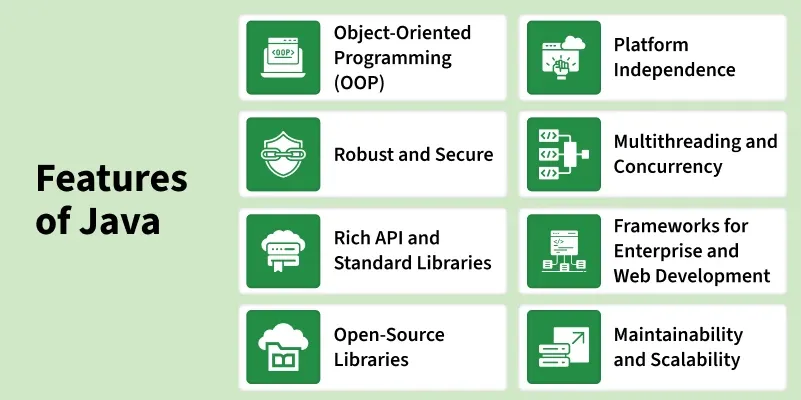
- Object-Oriented Programming (OOP): Java supports OOP concepts to create modular and reusable code.
- Platform Independence: Java programs can run on any operating system with a JVM.
- Robust and Secure: Java ensures reliability and security through strong memory management and exception handling.
- Multithreading and Concurrency: Java allows concurrent execution of multiple tasks for efficiency.
- Rich API and Standard Libraries: Java provides extensive built-in libraries for various programming needs.
- Frameworks for Enterprise and Web Development: Java supports frameworks that simplify enterprise and web application development.
- Open-Source Libraries: Java has a wide range of libraries to extend functionality and speed up development.
- Maintainability and Scalability: Java’s structured design allows easy maintenance and growth of applications.
Understanding Hello World Program
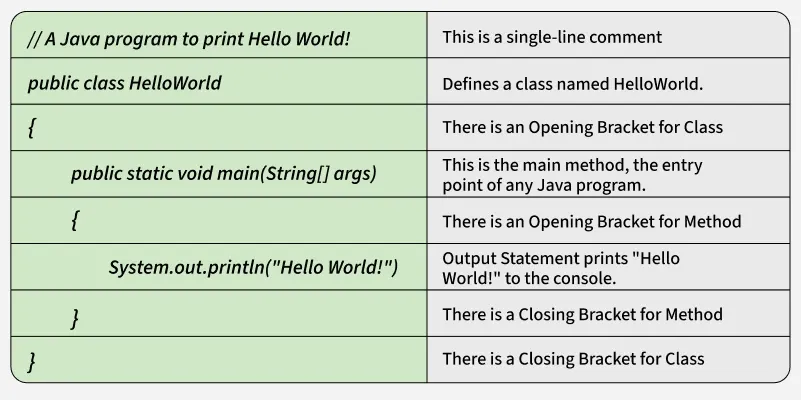
When we learn any programming language, the first step is writing a simple program to display "Hello World". So, here is a simple Java program that displays "Hello World" on the screen.
public class HelloWorld {
    public static void main(String[] args) {
        System.out.println("Hello World!");
    }
}
Output
Hello World!
Structure of a Java Program
The structure of a Java program defines the standard format for writing Java applications and includes essential components required for program execution.
How to run the above code?

- Write code in a file like HelloWorld.java.
- Java Compiler "javac" compiles it into bytecode "HelloWorld.class".
- JVM (Java Virtual Machine) reads the .class file and interprets the bytecode.
- The JVM initially interprets bytecode and uses JIT (Just-In-Time) compilation to convert frequently executed code into native machine code for better performance.
Famous Applications Built Using Java
- Android Apps: Most of the Android mobile apps are built using Java.
- Netflix: This uses Java for content delivery and backend services.
- Amazon: Java language is used for its backend systems.
- LinkedIn: This uses Java for handling high traffic and scalability.
- Minecraft: This is one of the world’s most popular games that is built in Java.
- Spotify: This uses Java in parts of its server-side infrastructure.
- Uber: Java is used for backend services like trip management.
- NASA WorldWind: This is a virtual globe software built using Java.
Uses of Java
Java is used for:
- Mobile App Development: Android development using Android Studio.
- Web Development: Using frameworks like Spring, Spring Boot, Struts, Hibernate
- Desktop GUI Applications: With libraries like JavaFX and Swing.
- Enterprise Applications: Backbone of banking, ERP and large-scale business software.
- Game Development: With engines like LibGDX and jMonkeyEngine.
- Big Data Technologies: Like Hadoop and Apache Kafka.
- Internet of Things (IoT): Java can run on embedded systems and devices.
- Cloud-based Applications: Java is used in services on AWS, Azure and Google Cloud.
- Scientific Applications: Java is used in tools that process large amounts of scientific data.