
Aspect Oriented Programming (AOP) is a programming approach used to separate cross-cutting concerns such as logging, security, and transactions from the main business logic. It improves code modularity and maintainability.
- Separates cross-cutting concerns from business logic.
- Reduces code duplication across multiple layers.
- Adds new behavior without modifying existing code.
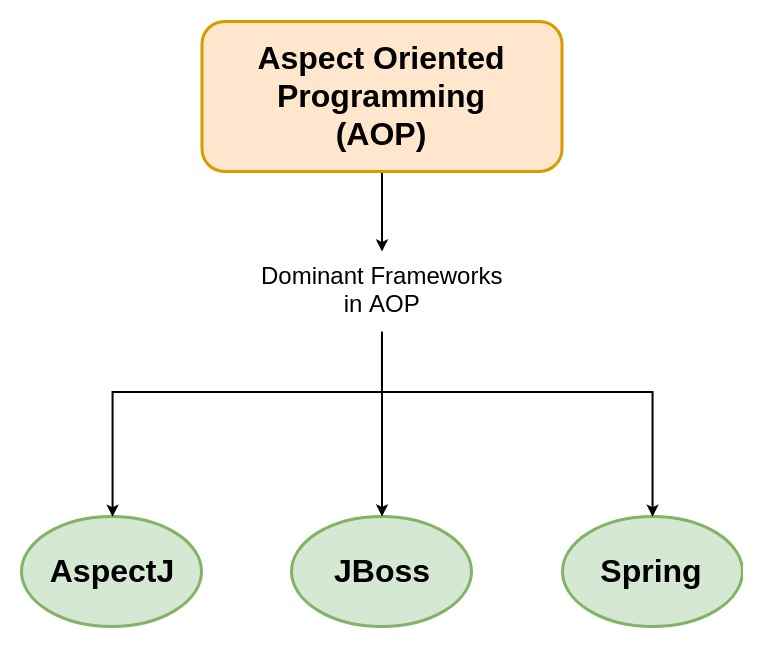
The aspect class provides us the flexibility to:
- Single Class for Concerns : Common concerns are defined in one aspect class instead of spreading across the code.
- Clean Business Logic : Business layer contains only main logic while secondary concerns are handled by aspects.
AOP Terminologies
Aspect-Oriented Programming (AOP) uses specific terminologies to define how cross-cutting concerns like logging and security are applied in an application. These terms help manage additional behaviors separately from the main business logic.
- Aspect: A module that contains cross-cutting concerns such as logging or security.
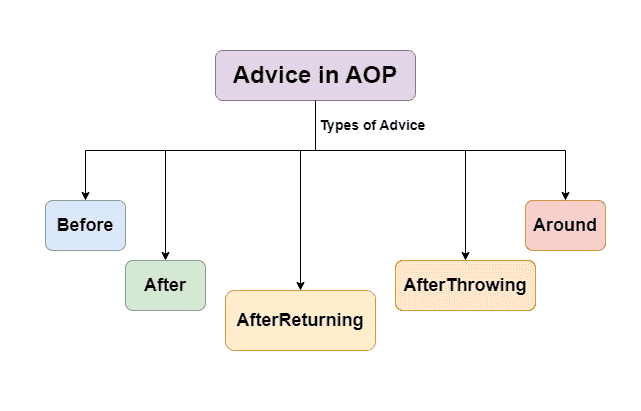
- Advice: The action or code that runs at a specific point during program execution.
| Terminology | Explanation |
|---|---|
| Aspect | A class that contains cross-cutting concerns like logging or security. Declared using @Aspect. |
| Advice | Code executed before or after a method. Types: Before, After, After-Returning, After-Throwing, Around. |
| Pointcut | Expression that defines where the advice should be applied. |
| Join Point | A point in the program where AOP can be applied (e.g., method execution). |
| Target Object | The object whose method is being advised by AOP. |
| Proxy | A proxy object created by Spring to apply advice to the target object at runtime. |
| Weaving | The process of linking aspects with the application code. |
Why do we need AOP?
In applications, some functionalities like logging, security, caching, and validation are used in many modules. These are called cross-cutting concerns.
- Avoids repeating common logic across classes.
- Keeps business logic clean and focused.
- Improves code maintainability and modularity.
Implementing cross-cutting concerns in every module makes the code lengthy and hard to manage. Aspect-Oriented Programming (AOP) solves this by placing these concerns in a separate aspect and applying them at specific points using pointcuts.
Example: Logging Aspect example
@Aspect
@Component
public class LoggingAspect {

    @Before("execution(* com.example.service.*.*(..))")
    public void logBefore(){
        System.out.println("Method execution started");
    }

    @After("execution(* com.example.service.*.*(..))")
    public void logAfter(){
        System.out.println("Method execution completed");
    }
}