
Bayes Theorem explains how to update the probability of a hypothesis when new evidence is observed. It combines prior knowledge with data to make better decisions under uncertainty and forms the basis of Bayesian inference in machine learning.
- Handles uncertainty and noisy data effectively
- Supports probabilistic interpretation of model predictions
- Enables learning even with limited data
- Plays a key role in real-world applications such as risk analysis and diagnosis
Mathematical Formulation of Bayes Theorem
Bayes Theorem describes the relationship between conditional probabilities and is mathematically expressed as:
P(A \mid B) = \frac{P(B \mid A) P(A)}{P(B)}
where
- Posterior Probability
P(A \mid B) : the updated probability of hypothesisA after observing evidenceB - Likelihood
P(B \mid A) : the probability of observing evidenceB assuming hypothesisA is true. - Prior Probability
P(A) : the initial belief about hypothesisA before observing any evidence. - Evidence (Marginal Likelihood)
P(B) : the total probability of observing evidenceB acting as a normalization factor.
Bayes Theorem for Multiple Hypotheses (n Events)
For a set of mutually exclusive and collectively exhaustive hypotheses
P(E_i \mid O) = \frac{P(O \mid E_i) P(E_i)}{\sum_{j=1}^{n} P(O \mid E_j) P(E_j)}
where
P(E_i \mid O) is the posterior probability of hypothesisE_i P(O \mid E_i) is the likelihood of observingO under hypothesisE_i P(E_i) is the prior probability ofE_i
Step By Step Implementation
Here in this code we implements a Naive Bayes classifier that uses Bayes Theorem to compute the probability of a message being spam or ham based on word frequencies trains the model on labeled data, evaluates its performance and predicts the class of new unseen messages.
Step 1: Install and Import Required Libraries
- Install essential Python libraries for data handling, ML modeling and visualization
- pandas is used for data manipulation
- scikit-learn provides ML algorithms and evaluation metrics
- matplotlib and seaborn are used for visualization
pip install pandas scikit-learn matplotlib seaborn

import pandas as pd
from sklearn.model_selection import train_test_split
from sklearn.feature_extraction.text import CountVectorizer
from sklearn.naive_bayes import MultinomialNB
from sklearn.metrics import accuracy_score, confusion_matrix, classification_report
import seaborn as sns
import matplotlib.pyplot as plt
Step 2: Load and Preprocess the Dataset
- Load the spam dataset using pandas
- Convert categorical labels into numeric values
You can download dataset from here
df = pd.read_csv("spam.csv", encoding='latin-1')[['v1', 'v2']]
df.columns = ['Label', 'Message']
df['Label'] = df['Label'].map({'ham': 0, 'spam': 1})

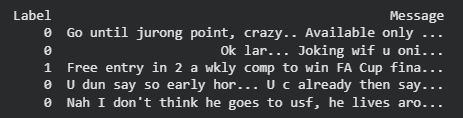
print(df.head())
Output:
Step 3: Separate Features and Target Variable
- Text messages are taken as input features
- Labels (0 for Ham, 1 for Spam) are the target variable
X = df['Message']
y = df['Label']
Step 4: Split Data into Training and Testing Sets
- Split dataset into 80% training and 20% testing
- random_state ensures reproducibility
X_train, X_test, y_train, y_test = train_test_split(
    X, y, test_size=0.2, random_state=42
)
Step 5: Convert Text Data into Numerical Form
- Machine learning models cannot process raw text
- CountVectorizer converts text into word frequency vectors
vectorizer = CountVectorizer()
X_train_vec = vectorizer.fit_transform(X_train)
X_test_vec = vectorizer.transform(X_test)
Step 6: Train the Naive Bayes Model
- Multinomial Naive Bayes is well-suited for text classification
- Train the model using vectorized training data
nb_model = MultinomialNB()
nb_model.fit(X_train_vec, y_train)
Step 7: Make Predictions on Test Data
- Use the trained model to predict spam or ham messages
- Predictions are stored for evaluation
y_pred = nb_model.predict(X_test_vec)
Step 8: Evaluate Model Performance
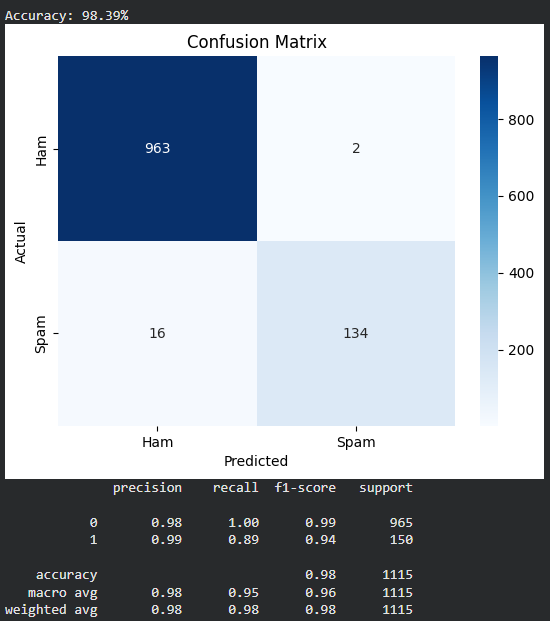
- Calculate accuracy to measure overall performance
- Generate confusion matrix for detailed analysis
- Display precision, recall, and F1-score
accuracy = accuracy_score(y_test, y_pred)
print(f"Accuracy: {accuracy*100:.2f}%")

cm = confusion_matrix(y_test, y_pred)
sns.heatmap(cm, annot=True, fmt='d', cmap='Blues',
            xticklabels=['Ham', 'Spam'],
            yticklabels=['Ham', 'Spam'])
plt.title("Confusion Matrix")
plt.xlabel("Predicted")
plt.ylabel("Actual")
plt.show()

print(classification_report(y_test, y_pred))
Output:
Step 9: Test the Model on New Messages
- Use the trained model to classify unseen messages
- Vectorize new messages using the same vocabulary
new_messages = [
    "Congratulations! You won a free ticket.",
    "Hey, are we still meeting today?"
]

new_vec = vectorizer.transform(new_messages)
predictions = nb_model.predict(new_vec)

for msg, pred in zip(new_messages, predictions):
    label = "Spam" if pred == 1 else "Ham"
    print(f"Message: '{msg}' => Prediction: {label}")
Output:
Message: 'Congratulations! You won a free ticket.' => Prediction: Spam
Message: 'Hey, are we still meeting today?' => Prediction: Ham
You can download full code from here
Applications of Bayes Theorem in Machine Learning
Bayes Theorem ability to handle uncertainty and incorporate prior knowledge allows models to make accurate predictions even with incomplete or noisy data like:
1. Naive Bayes Classifier: It is a simple probabilistic model based on Bayes’ theorem that assumes feature independence, making it efficient and effective for tasks like text classification and spam detection.
2. Bayes optimal classifier: The Bayes optimal classifier is a theoretical model that predicts the class with the highest posterior probability for given features, representing the best possible classification accuracy. It uses Bayes’ theorem to update probabilities based on new evidence.
\hat{y} = \arg \max_{y} P(y \mid x)
where
\hat{y} : Predicted class labely : Possible class labelx : Input feature vectorP(y \mid x) Posterior probability of class given features
3. Bayesian Optimization: Bayesian Optimization is a technique for efficiently finding the maximum or minimum of expensive to evaluate functions using a probabilistic model often a Gaussian process. It iteratively selects the most promising points to evaluate, making it ideal for tasks like hyperparameter tuning in machine learning.
4. Bayesian Belief Networks (BBNs): Bayesian Belief Networks (BBNs) or Bayesian networks are probabilistic graphical models that represent variables and their conditional dependencies using a directed acyclic graph (DAG). They are widely applied in risk analysis, diagnostics and decision-making.